- KPI & Target Setting
- ·
-
Jun 29, 2026
How to Set Business Targets That Actually Move: Reverse-Engineer Them From the Profit You Need
The year-opening meeting roars 'We're doing 20% more!'—and three months later nobody is walking toward that line. It's not that the team won't push; the 'last year + X%' formula gets cause and effect backwards. This piece shows you how to set business targets that move: reverse-engineer revenue from the net profit you need, set the breakeven floor, cascade to every role, tie it to reward.

Spark Liang
Managing Director, MMC Financial
How to Set Business Targets: Start From Net Profit, Not “Last Year + 20%”
How to set business targets is not a revenue question — it’s a profit question answered backwards. Business targets that actually move are set by reverse-engineering from the net profit you need: fix the profit first, add back overheads, divide by gross margin, and the revenue target and breakeven line calculate themselves. Then make them SMART, cascade them to every role, and tie them to reward.
You may know this picture: Ben, who runs an RM15M engineering contracting firm, opens the year with slide one in giant type — “do 20% more.” The room claps; three months later nobody is walking toward that line, and everyone swears they’re “pushing, lah.” The team isn’t the problem — the number had no math and no name behind it. Here’s the full method.
Why “Do 20% More” Is a Useless Business Target
Let’s blame the old playbook, not Ben. Almost every “how to set targets” lesson runs the same way: look at last year, add a percentage on top, call it this year’s target. The “last year + X%” approach is broken because it gets the cause and effect backwards.
It assumes one thing: revenue is the starting point. Set the revenue, and whatever profit falls out is whatever the gods decide. But what the owner actually wants was never revenue—it’s the net profit that lands in the bank. Push revenue up 20% while costs climb, margins compress, and a couple of bad debts slip through, and net profit can actually go down. Ben has watched too many peers get “bigger but poorer” by falling into exactly this trap.
So the first step in how to set business targets is not to ask “how much revenue do I want this year?” It’s to ask “how much net profit do I need to keep, and how much cash do I want to hold?” Lock that number down, then work all the way back—back to how many deals each salesperson has to close this month. This is the reverse-engineering method: set the profit endpoint first, then work backwards to the starting actions.
Staff Not Pushing? Check Whether the KPIs Are Tied to Money
Leave your WhatsApp and email and we'll take you straight to the pack.
How to Set Business Targets: Reverse-Engineer From the Profit You Need
Reverse-engineering, in plain terms, means doing the math backwards. Most people work down from revenue, subtracting costs until something is left over. You work up from net profit, adding costs back, so the revenue you have to do is calculated—not pulled out of thin air.
Here are Ben’s actual numbers:
Reverse-Engineering Your Target (do the math before you start)

Step 1: Set the endpoint—the net profit the owner needs
  Ben wants RM1.8M net profit (to fund a 2nd team + 6 months cash)

Step 2: Add back fixed overheads (payroll, rent, vehicles, interest…)
  Annual fixed overhead = RM3.2M

Step 3: Work out how much gross profit is required
  Required gross profit = RM1.8M net + RM3.2M overhead = RM5.0M

Step 4: Reverse-engineer revenue from the gross margin
  Ben's average gross margin = 25%
  Required revenue = RM5.0M gross profit ÷ 25% = RM20M

Step 5: Calculate the breakeven point
  Breakeven revenue = RM3.2M overhead ÷ 25% = RM12.8M
  → Below RM12.8M, the company starts losing money
See it? Ben’s real target was never “20% more” (RM18M). It’s RM20M in revenue—and behind every ringgit of that RM20M sits a result he actually wants. At the same time, for the first time, he knows his breakeven point is RM12.8M: drop below that line and he’s losing money just by opening the doors. Neither of those two numbers was anywhere on the “20% more” slide.
Reverse-engineering isn’t just math for the owner’s eyes. It forces the target to sit on the internal accounts the owner actually runs the business by—not the set you file for tax, the set you make decisions from. In those accounts, gross margin, fixed overhead, and the breakeven point are all visible, so the target finally has a foundation. To build reverse-engineering systematically into your budget, see our strategic profit budgeting service.
Side note: to see what revenue your own net-profit target reverse-engineers into, start with the free AI profit diagnosis — a real consultant, 30-45 minutes, no hard selling.
Make the Target SMART: Specific Enough to Be Measured
Reverse-engineering your way to “RM20M in revenue” still isn’t enough. Split RM20M across twelve months and three salespeople and it slides right back into a slogan—unless you make it SMART. SMART isn’t some lofty theory; it’s five checkpoints that make a target measurable:
- S — Specific: not “win more jobs,” but “sign 6 new project contracts this quarter”
- M — Measurable: every number is verifiable—revenue, gross profit, contracts signed, collection days
- A — Achievable: built on real capacity above the breakeven line, not the owner’s mood-of-the-day number
- R — Relevant: this role’s target genuinely drives the company’s RM1.8M net profit
- T — Time-bound: due by a specific date, not vague talk like “by year-end”
Same idea, two ways of saying it: “sales should work harder” is a slogan; “each salesperson signs RM5M this quarter, gross margin no lower than 25%, collection within 60 days, reviewed 30 June” is a SMART target. With the second one, three months later you can tell in one second who hit it and who didn’t.
Floor vs Stretch: Set Two Lines for Every Target (KFI)
Here’s the move most owners miss. Give a target a single number and your people only ever see two outcomes: hit or miss. Hit it and they exhale; miss it and they coast. That “just pass the bar” mentality is not what you want.
The right way is to give every Key Financial Indicator (KFI) two lines:
- The floor: hold this and the company doesn’t lose money and the role is doing its job. This is the baseline—miss it and there’s accountability.
- The stretch: the line you reach by standing on your toes and jumping, with extra reward if you get there. This is the pull that makes someone go one step further.
For example, here’s what Ben set for each salesperson:
Two lines for the sales role (per quarter)

Floor = RM4M signed, gross margin ≥ 23%
  → Hold it: company breaks even, base pay + standard bonus kept

Stretch = RM5.5M signed, gross margin ≥ 27%
  → Hit it: an extra 2% bonus on the surplus

The gap in between (RM4M → RM5.5M) is the company's growth room this year
With two lines, the mindset is completely different. The floor gives security (I can hold it); the stretch gives drive (jump and there’s meat on the bone). The effort you can’t squeeze out with one number, two lines can.
Cascade to Every Role: Every Number Needs a Name Behind It
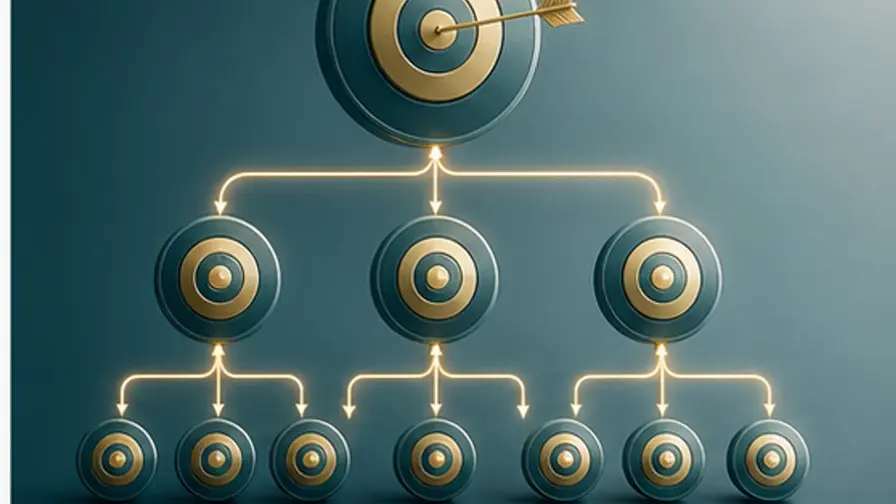
Targets die, nine times out of ten, because “the company has a target but no one at the role level owns it.” RM20M hangs on the wall, never broken down, so nobody claims it. The final gate in how to set business targets is to break that one big company number down, layer by layer, onto every role and every person—this is target cascading.
The logic of the breakdown is: the target at each level equals the sum of the targets at the level below it.
How the Target Cascades Down
Company target RM20M revenue → split into the sales team (say RM16M) + existing-client renewals (RM4M) → the sales team splits across 3 salespeople (about RM5.3M each) → each salesperson breaks it into monthly and weekly contract counts and site visits. By the end, every salesperson wakes up knowing how many calls to make and how many sites to visit today. Only then is someone actually walking the RM20M on the wall forward.
The one piece of discipline that matters: behind every number must stand a person with a name. A number nobody owns will come up empty by year-end. This method—cascading from the company target all the way down to individual actions—is exactly what we walk owners through hands-on in our organizational KPI alignment service; to see how a target passes down the layers without losing its shape, read The Chick Theory: How Target Cascading Reaches the Front Line.
Tie It to Reward: A Target Only Gets Pushed When It’s Tied to Money
The last step—and the one most owners go soft and skip—is this: tie the target to reward. However beautifully you cascade a target, if hitting it pays the same as missing it, why would anyone push for you?
The logic is simple and ties back to the two lines: reach the floor, you keep base pay and standard bonus; clear the stretch, you take extra bonus on the surplus (say 2%–5% of the excess gross profit). Money follows the stretch line, so your people’s eyes naturally follow the stretch line too. This is the mechanism that translates “the company wants to make money” into “I close one more deal, I’m one ringgit richer.”
Reward isn’t a cost—it’s the weld that fixes the target onto your people. Without that weld, even the most SMART target is just a report nobody reads by month-end.
Three Things an Owner Can Do This Week
No need to wait for next year’s big meeting—you can start these three this week:
- Calculate your needed net profit first, then reverse-engineer revenue. Take your net profit target, add back fixed overheads, divide by gross margin, and work out the real revenue target and breakeven line. Stop starting from “do X% more.”
- Pick one role and set a floor and a stretch line. Start with sales—it’s the most direct. Give a specific, measurable, time-bound two-line target and see how far it is from “you need to work harder.”
- Tie one target to reward. Even just one salesperson, one quarter to start: clear the stretch, share a bit more. Let the person see with their own eyes that “hit the target, and my pay changes.”
FAQ
How do you set business targets so they don’t turn into slogans?
Business targets that actually move share three traits. First, they’re reverse-engineered from net profit—you set how much you need to earn, then work back to the revenue and breakeven point required, instead of “last year + 20%.” Second, they’re SMART (specific, measurable, achievable, relevant, time-bound), so three months later you can tell at a glance who hit them. Third, they’re cascaded to every role, with a named person standing behind every number and reward tied to it. Drop any one of these and the target collapses back into a slogan—a number with no profit math and no owner will never move on its own.
How should you actually set sales targets?
Sales targets shouldn’t start from “how much revenue do we want.” They should be reverse-engineered from the net profit the company needs. First use the reverse-engineering method to calculate the total company revenue required, then cascade it down to the sales team and onto each salesperson, expressed as a SMART target (e.g. “sign RM5M this quarter, gross margin no lower than 25%, collection within 60 days, reviewed 30 June”). Then give each salesperson two lines—a floor and a stretch: hold the floor to be doing the job, clear the stretch to earn extra bonus. Sales targets set this way carry both baseline accountability and a pull to stretch.
Why set a floor and a stretch line separately?
With a single target number, employees only ever see “hit or miss,” so they ease off once they pass and coast once they fall behind. Two separate lines change the mindset entirely. The floor is the baseline—hold it and the company doesn’t lose money and the role is doing its job—giving the employee security. The stretch is the higher line reached on tiptoe, with extra reward if you get there—giving the employee drive. The gap between the two lines is the company’s growth room for the year. The effort you can’t force out with one number, two lines plus reward will pull out.
Stop Letting a Slogan Stand In for This Year’s Business Target
Ben stopped shouting “do 20% more.” He reverse-engineered RM20M of revenue from the RM1.8M net profit he needed, locked down his breakeven line, cascaded it onto each salesperson, and tied reward to every line. Same people, same market—only the way the target was set changed, and for the first time someone was actually walking toward that year-end line. If your target this year is still a slogan on a slide, the problem isn’t that your team isn’t trying hard enough—it’s that there’s no math, and no name, behind the number.
To build this system—reverse-engineered from net profit, cascaded to every person, tied to reward—into your company, book a strategy call with us, or sign up for the Budget Management (3+1)-Day Program and we’ll run this year’s targets on your own numbers.
Reading Is Free. So Is Seeing Your Own Numbers.
You've just read the theory — now apply it to your own company. Use the AI ROI calculator, then let MMC's licensed team take a free look at where your revenue, profit and cash are leaking. A real consultant, no hard sell — and the 30-45 minutes could give you back ten hours a week.