- KPI & Target Setting
- ·
-
Mar 30, 2026
The Chick Theory: How to Cascade an RM10M Target Down to Every Person
The whiteboard says '2026: RM10M', the kickoff photos look great—and by December the number is three million short. Not because the team is lazy, but because the target never got translated into 'what this person finishes this week.' This piece shows you the Chick Theory of target cascading: five stages with metrics, result plus process breakdowns, down to each person's weekly number.

Spark Liang
Managing Director, MMC Financial
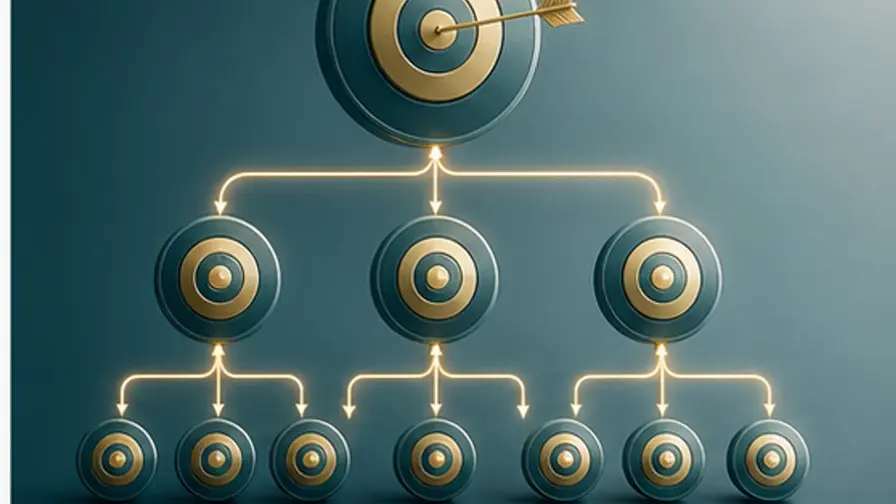
The Chick Theory: Target Cascading Down to What Each Person Does This Week
Targets aren’t set — they’re cascaded. The Chick Theory is a target cascading method that splits a business into five stages — leads, quotes, orders, delivery, referrals — gives each stage one metric, then uses a result breakdown to settle who carries how much money and a process breakdown to settle what each person does this week. No one can carry RM10M; anyone can carry “book 2 quotes this week.”
You may know this picture: the kickoff crowd has gone home, you’re the last one in the office, and the whiteboard says “2026: RM10M” with an arrow pointing up. You wrote a similar number last year and ended December three million short — not because the team was lazy, but because nobody knew how that number connected to the calls they make today. Here’s the cascade, layer by layer.
The Reversal: It’s Not That Staff Are Lazy—The Target Was Never Translated Into Action
The line bosses say most often: “I made it crystal clear—we need RM10M. So why can’t they deliver?”
Stating a target and breaking a target into actions are two completely different things.
RM10M is a result to the boss. To Ahmad in sales, it’s fog. He knows the company wants RM10M. What he doesn’t know is what he should do today that counts as “helping earn that RM10M.” So he runs on gut—follows up when it feels right, scrolls his phone when he’s tired. He’s not lazy. The system never handed him a clear “small target for today.”
Put the blame back where it belongs—on the mechanism. When execution falls short, nine times out of ten it’s because the target breakdown fell short. The company handed him one big number settled once a year. What he needs is a small number he can score himself on every week. The missing layer of translation in between is a gap in the mechanism, not a failing of the staff.
The Method: The Chick Theory—Breaking a Business Into Five Egg-Laying Stages
I’ve shared a framework with a lot of bosses that’s deliberately unglamorous but impossible to forget: the Chick Theory. A business, at its core, is a chicken farm.
- Leads = eggs: how many prospect names you hold is how many eggs you have. No eggs, nothing downstream.
- Meetings & quotes = incubating the eggs: getting names to a meeting and putting a quote in front of them is warming the eggs. Not every egg hatches.
- Orders = chicks: the customer buys, the egg becomes a chick. This is where it actually begins.
- Delivery = raising the chick: deliver the goods, deliver the service, keep the chick healthy so it doesn’t die mid-way (returns, complaints, bad word of mouth).
- Repeat & referrals = the hen that lays eggs: a well-raised customer buys again and refers new customers—now that chick is a laying hen, and one hen produces a whole brood.
Every stage needs one goal plus one metric, or staff have nothing to chase:
| Stage | Goal | Metric (what you watch weekly/monthly) |
|---|---|---|
| Leads (eggs) | Enough new prospects each week | New leads added |
| Meetings & quotes (incubating) | Turn names into quote opportunities | Quotes issued, meeting rate |
| Orders (chicks) | Turn quotes into closed deals | Deals closed, close rate |
| Delivery (raising) | Deliver on time, error-free | On-time delivery rate, return/complaint rate |
| Repeat & referrals (the hen) | Make old customers buy again and bring new ones | Repeat rate, referrals generated |
Lay these five layers out and the boss sees something important: “sales are bad” was never one problem—it’s five different problems. Not enough eggs (too few leads)? Eggs not hatching (can’t get meetings or quotes)? Chicks dying after hatching (closing deals then botching delivery)? Each layer has a completely different cure.
Side note: to find out which of these five layers is leaking in your own company, start with the free AI profit diagnosis — a real consultant, 30-45 minutes, no hard selling.
Two Ways to Break It Down: Result Breakdown vs Process Breakdown
Knowing the five stages isn’t enough. You also have to cascade that RM10M down. There are two ways to do it, and you need both.
Method 1: Result breakdown (slice down the org chart)
Cut RM10M from company, to division, to team, to each individual:
Company target: RM10M
  ├─ Division A (existing-customer repeat): RM4M
  │     ├─ Team 1: RM2.5M
  │     │     ├─ Ahmad: RM1M
  │     │     └─ Mei: RM1.5M
  │     └─ Team 2: RM1.5M
  └─ Division B (new-customer acquisition): RM6M
        ├─ Team 3: RM3.5M
        └─ Team 4: RM2.5M
Result breakdown answers: “Who carries how much money?” Ahmad carries RM1M this year. That’s his number now, not the boss’s.
Method 2: Process breakdown (work forward through the Chick Theory stages)
Result breakdown tells Ahmad to carry RM1M, but he still doesn’t know what to do today. That’s where process breakdown comes in—working backward from the result to each individual action.
Say at the company level we use the conversion rates of these five stages to back-calculate:
Target revenue: RM10M
Average order value: RM100k
→ Orders needed: 10M ÷ 100k = 100 orders

Quote-to-close rate: 10% (1 close per 10 quotes)
→ Quotes/meetings needed: 100 ÷ 10% = 1,000 quote opportunities

So across the year we must feed in 1,000 "eggs" (meetings & quotes)
to hatch 100 "chicks" (orders) and raise RM10M.
1,000 prospects × 10% close rate × RM100k per order = RM10M.
Now take those 1,000 quote opportunities and split them back across each team and each person using the result-breakdown ratios. Ahmad carries RM1M—that’s 100 quote opportunities and 10 orders. Divide by 52 weeks and his weekly target is crystal clear: book 2 meetings/quotes, work the follow-ups.
That is what landing a target looks like. Ahmad never has to think about RM10M again. He just makes sure he feeds in 2 eggs a week, and the big chicken raises itself by year-end.
Result Breakdown Answers 'How Much Money'; Process Breakdown Answers 'What To Do Today'
Result breakdown alone gives staff pressure with no method—they know it’s RM1M, not how it gets there. Process breakdown alone gives staff actions with no ownership—they know to make calls, not what for. Only both together produce people who carry responsibility AND know the moves. This double cascade of result plus process is exactly the work between Strategy and Measure in the OGSM framework.
Staff Not Pushing? Check Whether the KPIs Are Tied to Money
Leave your WhatsApp and email and we'll take you straight to the pack.
Four Steps You Can Start This Week
You don’t have to wait for the next kickoff. You can start cascading your target this week:
- Step 1: Draw your own five chick stages. Take one sheet of paper. Write your five stages from “leads” to “referrals” and fill in roughly where each number sits today. Just filling in this table will show you which layer is leaking.
- Step 2: Calculate the conversion rate at each stage. How many leads came in last month? How many became quotes? How many closed? Work out the conversion at every layer—only then do you know how many eggs you need to feed in.
- Step 3: Run a result breakdown of annual revenue. From company to division to team to individual, put a specific ringgit figure on every head. Give every staffer “their own number.”
- Step 4: Run a process breakdown of each person’s number down to the week. Use the conversion rates to work backward and tell each staffer: this week, book X meetings, send Y quotes, chase Z follow-ups. Turn the big annual target into small weekly actions they can score themselves on.
Do these four steps and your whiteboard stops being an empty RM10M and becomes a battle map of “what each person does this week.” For how these individual metrics align to company strategy and avoid everyone pulling in different directions, see our Organizational KPI Alignment service.
FAQ
How is the Chick Theory different from a normal sales funnel?
A normal sales funnel usually stops at “closed deal.” The Chick Theory adds two critical layers—“delivery (raising)” and “repeat & referrals (the laying hen).” For SMEs, 80% of profit actually comes from repeat purchases and referrals from existing customers. Watching only the close while ignoring delivery and repeat means you re-hatch eggs every year and never raise a laying hen. The Chick Theory forces the boss to track metrics all the way to customer lifetime value.
When cascading an RM10M target, how many metrics should each stage have?
One core metric per stage is enough, two at most—the point is “few and precise.” Leads: new leads added. Quotes: quotes issued. Orders: close rate. Delivery: on-time delivery rate. Repeat: referrals generated. The more metrics you add, the less focus your staff have. Start with one metric so every stage can be scored weekly, get it running smoothly, then consider a second.
Result breakdown or process breakdown—which should I do first?
Do result breakdown first, then process breakdown. Use result breakdown to cut RM10M from company down to each person and settle “who carries how much money,” landing the responsibility. Then use process breakdown to back-calculate each person’s figure into “how many meetings and quotes this week,” landing the action. Reverse the order and staff see a pile of actions with no idea who they’re working for.
A Final Word
Targets aren’t set—they’re cascaded. An RM10M target, the moment you’re willing to break it down layer by layer to how many eggs each staffer feeds in this week, stops being a slogan on the wall and becomes a battle assignment in each person’s hands. If you want to systematically install this Chick Theory, result breakdown and process breakdown into your company alongside a full KPI and profit-sharing mechanism, take a look at our Budget Management (3+1)-Day Program, or first read our piece on KPI vs OKR: Choosing the Right Goal-Setting Framework to figure out which tool to use once the target is broken down.
Reading Is Free. So Is Seeing Your Own Numbers.
You've just read the theory — now apply it to your own company. Use the AI ROI calculator, then let MMC's licensed team take a free look at where your revenue, profit and cash are leaking. A real consultant, no hard sell — and the 30-45 minutes could give you back ten hours a week.